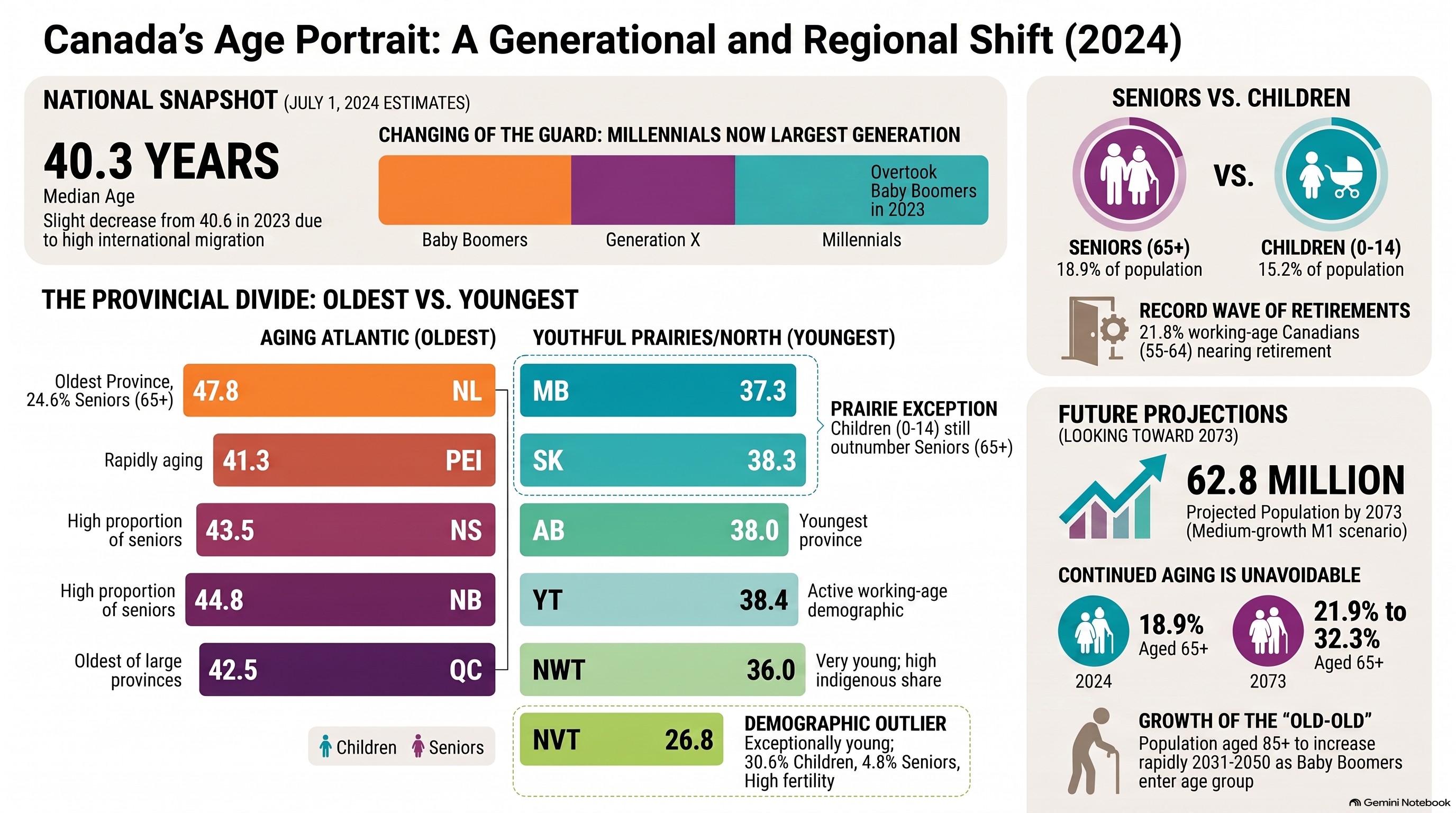
The demographic case for the moving industry looks obvious at first glance. Canada's population is aging. Baby boomers are retiring in record numbers. Seniors now outnumber children. A wave of downsizing moves must be coming.
The data says otherwise, at least for the next three to five years. Seniors are currently among the least likely Canadians to move, and the reason is specific and well documented. Meanwhile the group actually generating move volume right now is the one most people would guess wrong.
This piece works through what the numbers say, where the near-term volume actually sits, and what the genuine senior opportunity looks like once you understand its real shape and timing.
First, the Demographic Picture, Updated
The infographic above, built from Statistics Canada's July 2024 estimates, is a good starting point, and every figure on it checks out against Statistics Canada's own releases. It is also one year out of date in a way worth flagging before we go further: Statistics Canada's July 2025 estimates show the median age rose back to 40.6 years, resuming the long-term aging trend that ran from 1967 to 2021, after the slight dip the infographic captures. The share of Canadians aged 65 and older reached 19.5% in 2025, up from the 18.9% shown above.
The 2025 data also contains a first the infographic predates: for the first time, the proportion of people aged 65 and older surpassed one in four in a Canadian province or territory. Newfoundland and Labrador, already shown above as the country's oldest province, crossed that threshold.
Millennials becoming Canada's largest generation, also shown above, is confirmed directly by Statistics Canada. Between July 2021 and July 2024, more than 1.1 million people joined the millennial cohort, almost entirely through international migration, since migrants skew toward the 20 to 40 age range.
Hold onto that last point. It matters more than the aging headline.
The Assumption That Does Not Survive Contact With the Data
If an aging population meant more moves, seniors would be moving. They are not.
A RE/MAX Canada survey published in April 2026 found that just 10% of Canadians expect to move to a smaller home within the next decade. Among seniors specifically, that figure rises only to 16%, while 46% say they plan to stay exactly where they are.
of Canadian seniors expect to downsize within the next decade. 46% plan to stay exactly where they are.
The reason is not sentimentality. It is supply. That same survey found 65% of Canadians aged 65 and older report low or no availability of suitable downsizing housing in their communities, and 73% expressed concern about their downsizing options, including 32% who described themselves as very concerned. Nearly half of all Canadians, 49%, report low availability of downsizing housing, with a further 8% saying there are no options at all.
Seniors are not refusing to move. Many have nowhere to move to.
The preference data points the same direction. A 2020 National Institute on Ageing survey found 96% of Canadians aged 65 and older said they would do everything they could to avoid entering a long-term care facility. A Deloitte Canada report found 91% of Ontario seniors hope to stay in their own homes as long as possible. Royal LePage research found 74% of respondents were increasingly interested in aging in place specifically because of the cost of senior care facilities, with CMHC putting average rent for a standard seniors' housing space at $3,075 per month.
Economic conditions are compounding the effect. Reporting from May 2026 found retirees actively delaying downsizing plans, held back by both soft home prices and the cost of moving itself, with some postponing relocation to financially support adult children longer than planned.
A methodology caveat worth stating plainly: the RE/MAX and related surveys referenced above are online panel surveys. As the Canadian Research Insights Council notes, such surveys cannot be assigned a margin of error because they do not randomly sample the population. They are directionally useful and consistent with each other, but they are not the same class of evidence as census data, and treating them as equivalent would be a mistake.
Where the Volume Actually Is
Statistics Canada's own analysis of mover behaviour is unambiguous on this point. In the two years leading up to 2021, 2.1 million Canadian households moved, representing 13.8% of households. Among those movers, renters accounted for 1.2 million and owners for 870,000. Renters moved substantially more, despite renters being roughly one in three Canadians rather than the majority.
That is the mechanism that matters. Moving volume tracks tenure far more closely than it tracks age.
And Canada's rental population is growing on both ends. Between the 2011 and 2021 censuses, the number of renter households grew 21.5% while homeowners grew just 8.4%, and renters grew faster than owners in all 41 large urban centres in the country. Nearly two-thirds of Canadians aged 15 to 29 are renters.
Then there is the millennial squeeze, which Statistics Canada documented directly in a study released in May 2026. After adjusting for young adults living with parents longer, millennials had a homeownership rate of 49.9% in 2021, below Gen-Xers at the same age in 2006 (56.2%) and baby boomers in 1991 (55.9%). The proportion of millennials aged 25 to 39 living in a census family with at least one parent reached 16.3% in 2021, nearly double the boomer rate of 8.2% in 1991, and rising to 26.1% in Toronto and 19.3% in Vancouver. Millennials were also less likely to own single-detached houses than earlier generations.
The strategic read: the largest generation in the country is staying in the rental market longer than any generation before it. Renters move more often than owners. That combination, not the aging curve, is what drives near-term residential moving volume.
Statistics Canada's data on why people move fills in who these customers actually are. Among movers aged 15 to 24, 52.3% cited forming their own household, school, or employment. Among millennials aged 25 to 40, the leading reasons were a change in household size (16.9%), employment (15.8%), being close to family (19.1%), and reducing commute time (10.4%). Across all movers, the single most common reason was seeking bigger or better housing (28.0%), followed by seeking a more desirable neighbourhood (16.8%).
Those are moves driven by life stage, not by the housing market cycle. They happen regardless of interest rates.
One Signal Worth Watching Closely
There is a variable that could meaningfully change move volume in either direction over the next few years, and it is not demographic.
CMHC's 2025 Rental Market Report found the average vacancy rate for purpose-built rental apartments across Canada's largest metro areas rose to 3.1% in 2025, up from 2.2% in 2024 and above its ten-year average. For comparison, CMHC recorded a rental turnover rate of 13.5% in 2021, down from 15.5% in 2020, a decline attributed at the time to extremely tight vacancy conditions making it hard for renters to find anywhere to go.
The relationship is direct: when vacancy is tight, renters who want to move cannot, and turnover falls. As vacancy loosens, previously stuck renters become able to move, and turnover rises. Statistics Canada has explicitly connected deteriorating rental affordability to substantial barriers to shelter mobility, impeding or delaying the ability of families to move.
If the vacancy loosening seen in 2025 continues, a share of renters who have been unable to move becomes able to. For a moving company, rental vacancy rates in your market are a more useful forward indicator of near-term volume than the national aging curve.
The Senior Opportunity Is Real, But It Is a Different Shape
None of this means the aging population is irrelevant. It means the opportunity has a different timeline and a different trigger than the simple version suggests.
Two things distinguish it. First, it is supply-gated rather than demand-gated. British Columbia's Office of the Seniors Advocate pegged the province's long-term care bed shortfall at 2,000 in January 2026, with provincial figures indicating BC will need 16,000 new long-term care beds over the next decade to close the gap between projected supply and demand, against a senior population projected to grow 26% in ten years. Ontario faces similar pressure, with long-term care wait times measured in months or years and the province at risk of missing its own bed construction targets. Senior moves in volume require senior housing to exist. That construction is behind schedule across multiple provinces.
Second, the moves that do happen skew toward necessity rather than choice. As the infographic above notes, Statistics Canada projects the population aged 85 and older will grow rapidly between 2031 and 2050 as baby boomers enter that age group, part of a broader projection that the senior share of the population could reach between 21.9% and 32.3% by 2073 depending on the aging scenario. Home adaptation data illustrates the transition already underway: 25.0% of Canadians aged 65 to 79 had used home adaptations, rising to 51.9% among those 80 and older. Moves in this cohort are typically triggered by a health event or a care need, not by a decision to rightsize, and they are often coordinated by an adult child rather than the person moving.
That is a real and growing market. It rewards different things than a millennial rental move does: sensitivity, patience, clear communication with family members who are not present, and careful handling of possessions with high sentimental value. It is worth building capability for. It is not where the next twenty-four months of volume comes from.
What This Means in Practice
Do not build your near-term marketing around the aging narrative. The demographic headline is real, but the behaviour it implies is not showing up in mover data. Seniors are the least mobile group in the country right now, and the constraint is housing supply that has not been built yet.
Renters, especially millennial renters, are where residential volume concentrates. They move more often than owners, they are the largest generation, and they are staying in the rental market longer than any prior generation. The specific triggers to build around are household size changes, employment moves, moving closer to family, and simply seeking better housing.
Watch local rental vacancy rates. They are a more direct leading indicator of near-term move volume in your market than national demographic projections, and they are published regularly by CMHC.
Build senior-move capability deliberately, not urgently. The demand is coming, gated by seniors housing construction rather than by demographic readiness. Companies that develop genuine competence in health-triggered moves, family-coordinated decisions, and careful handling will be positioned when supply catches up. That is a three-to-five-year investment, not a next-quarter campaign.
The broader point is one we have made before on this blog: the obvious read of a demographic trend and what the behavioural data actually shows are frequently different things. Canada is aging. Canadians are not moving because of it, at least not yet.
Sources
- Statistics Canada, "Canada's population estimates: Age and gender, July 1, 2024": statcan.gc.ca
- Statistics Canada, "Canada's population estimates: Age and gender, July 1, 2025": statcan.gc.ca
- Statistics Canada, "Population projections: Canada, provinces and territories, 2023 to 2073": statcan.gc.ca
- Statistics Canada, "Study: Millennials in the housing market" (May 6, 2026): statcan.gc.ca
- Statistics Canada, "Canadians on the move": statcan.gc.ca
- Statistics Canada, "The Canadian rental conundrum" (October 2025): statcan.gc.ca
- Statistics Canada, "Aging in the community: Factors associated with home adaptations" (2025): statcan.gc.ca
- RE/MAX Canada downsizing survey, as reported by Real Estate Magazine (April 2026): realestatemagazine.ca
- Advisor.ca, "Retirees delay downsizing plans as housing market slumps" (May 2026): advisor.ca
- National Seniors Council, citing National Institute on Ageing 2020 survey: canada.ca
- Journal of Commerce, "B.C. faces long-term care shortage" (March 2026), citing BC Office of the Seniors Advocate: constructconnect.com
- Daily Commercial News, "Ontario to boost home care funding, may miss long-term care bed goal" (March 2026): constructconnect.com